
Last updated August 25, 2026
Free on-site gate assessment - hinges, posts, and your LiftMaster or Nice gate operator checked before anything is quoted
The assessment is free and the quote is the invoice.
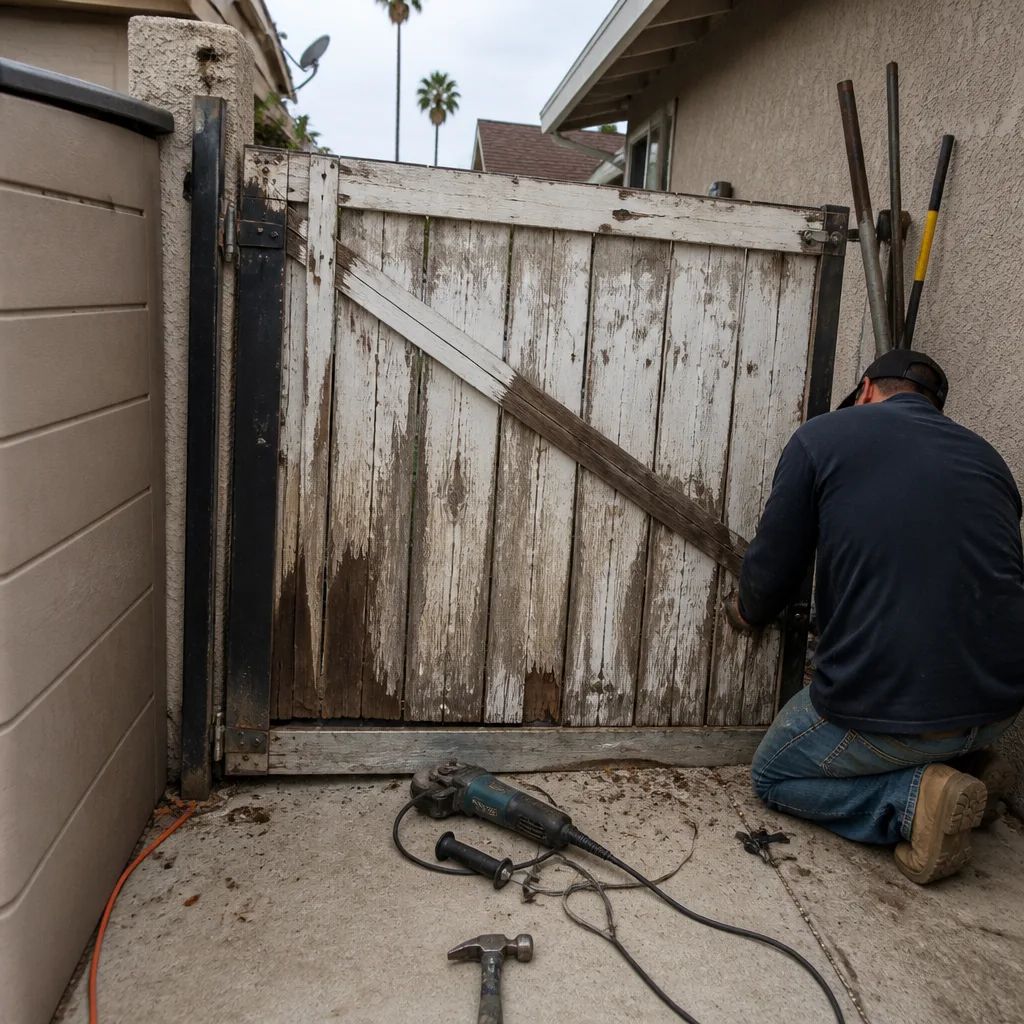 Before
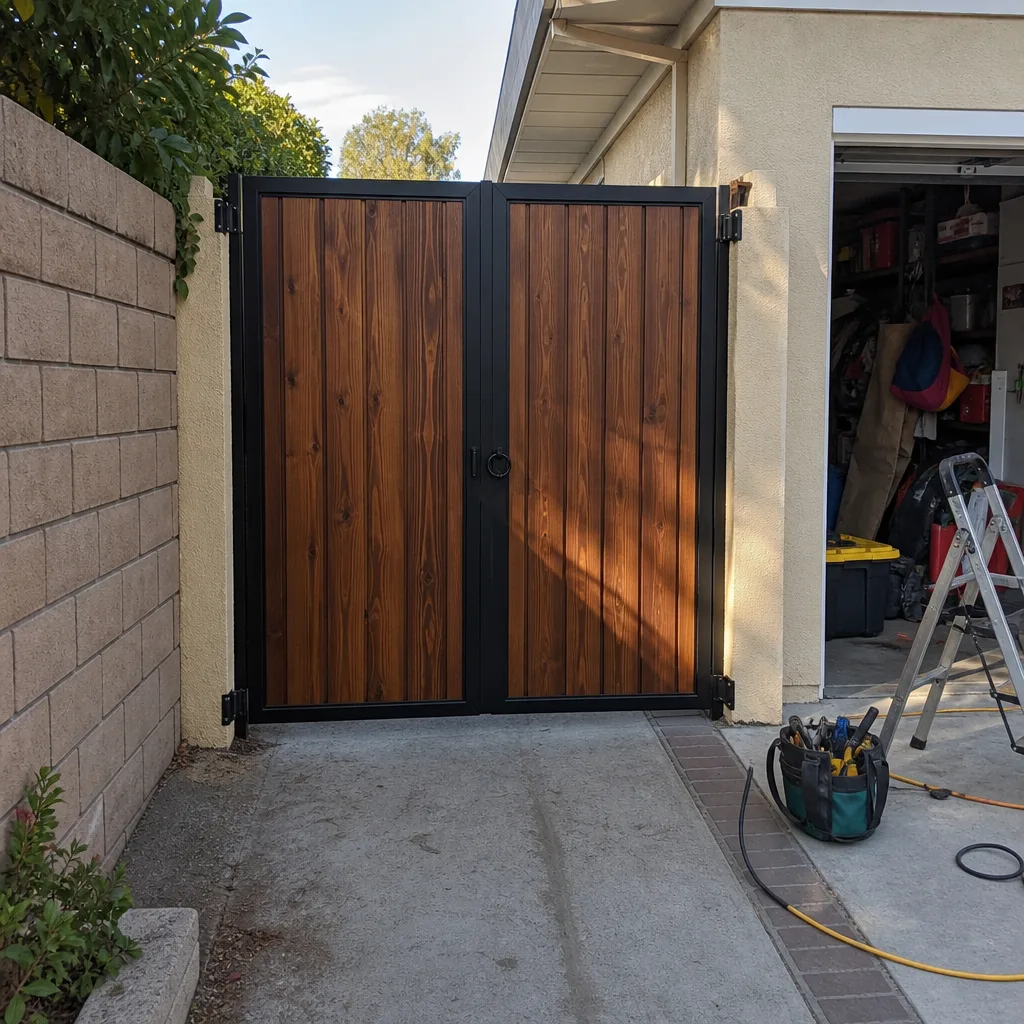 After
After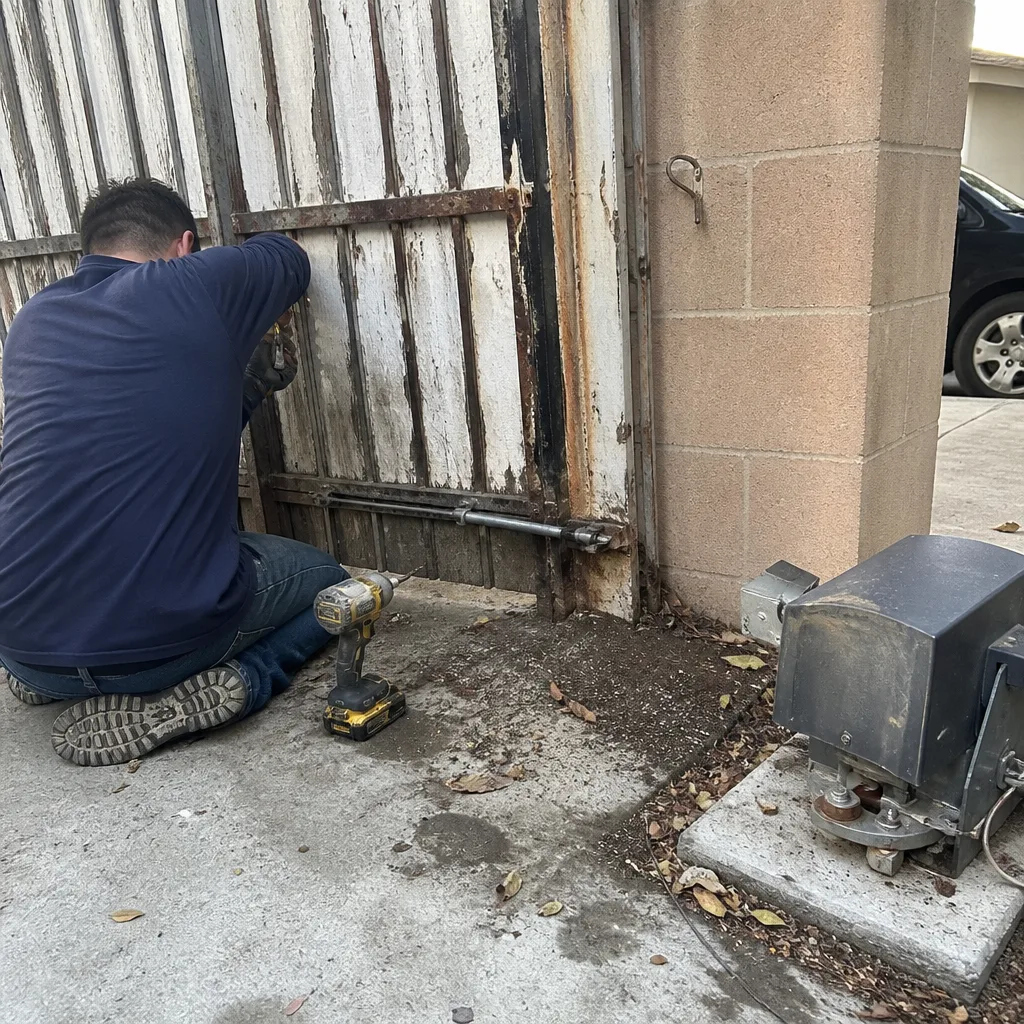 Before
 After
After Before
 After
AfterDIY vs Professional Gate Repair: The Fullerton Homeowner’s Decision Guide
Here’s something most Fullerton homeowners discover the hard way: a driveway gate weighs between 300 and 800 pounds, and when a spring or hinge lets go, that weight doesn’t ask permission. We’ve pulled warped gates off cars, patched stucco where a gate punched through, and replaced motors that burned out because a homeowner tightened a chain one turn too many. This guide walks you through what you can safely handle yourself, what you shouldn’t touch, and how to tell the difference before you’re standing in the driveway holding a broken part and a mounting hardware bill. You’ll learn the real costs of both paths, the Fullerton-specific factors that change the math, and the questions to ask any contractor before they set foot on your property.
Quick Answer
For a Fullerton homeowner with basic hand tools and patience, DIY gate repair makes sense for cosmetic fixes, minor hardware replacement like latch adjustment or hinge lubrication, and low-voltage photo-eye alignment on an opener system. Anything involving gate springs, load-bearing hinges, welded joints, or the motor and control board itself should go to a professional, because the weight and tension involved can cause serious injury, and because a gate that fails after a DIY fix often costs two or three times more to repair correctly than it would have cost to fix right the first time.
Table of Contents
- What Most Fullerton Gate Repairs Actually Involve
- Why Fullerton’s Climate Is Hard on Gates
- The Repairs a Fullerton Homeowner Can Honestly DIY
- When DIY Turns Dangerous (And Expensive)
- Fullerton Cost Comparison: DIY vs Hiring a Professional
- Questions to Ask Anyone Who Touches Your Gate
- A Word on Automatic Openers: LiftMaster, Mighty Mule, and the Rest
- Common Mistakes to Avoid
- When to Call a Professional
- Frequently Asked Questions
- The Bottom Line
What Most Fullerton Gate Repairs Actually Involve
We’ve been working on driveway gates across Fullerton since 2013, and the calls we get break down into a handful of familiar patterns. A gate that drags on the ground usually means a sagging hinge or a post that’s shifted in the soil. A gate that won’t close all the way is typically a latch alignment problem, a warped picket, or a photo-eye that’s drifted out of line. A gate that opens fine but reverses halfway is almost always a force-setting or safety-sensor issue on the opener. And a gate that simply won’t move at all? That’s usually electrical: a dead capacitor, a fried control board, or a motor that’s been fighting a misaligned gate for months and finally gave up.
The repair itself usually falls into one of five categories:
- Hardware replacement: hinges, latches, rollers, wheels, and brackets. This is the most common repair on manual gates and often the most approachable for a competent DIYer.
- Welding and structural work: cracked welds, bent frames, rusted-through pickets. This requires equipment, technique, and an eye for load distribution that most homeowners don’t have sitting in the garage.
- Opener and motor service: diagnosing and repairing the electrical and mechanical components of an automatic gate system. This is where we see the most expensive DIY mistakes.
- Access control: keypads, remotes, intercoms, vehicle detection loops. Usually low-voltage but frustrating, because the symptoms rarely point directly at the cause.
- Full replacement: when the gate has rusted beyond repair, been hit by a vehicle, or was never hung properly in the first place. In older Fullerton neighborhoods like the area around Chapman and Raymond, we still see a fair number of original gates from the 1960s and 70s that have simply reached the end of their working life.
Understanding which category your problem falls into is the first step in deciding whether to pick up a wrench or pick up the phone.
Why Fullerton’s Climate Is Hard on Gates
Fullerton sits in a sweet spot for homeowners: warm, dry summers, mild winters, and just enough coastal influence to keep things comfortable. But for a metal gate, this climate creates specific challenges. The dry heat accelerates paint and powder-coat degradation on the sun-facing side of the gate, which is why we so often see gates in Fullerton with rust on the west-facing side and relatively intact finish on the east-facing side. The summer temperature swings between Fullerton’s daytime highs and cooler nights cause metal to expand and contract, slowly working screws loose and stressing weld points on gates that have been in service for fifteen or twenty years.
And then there’s the water. Fullerton doesn’t get much rain, but when it does come, it tends to pool at the base of gate posts, especially in neighborhoods with heavy clay soil like the areas north of Commonwealth. That moisture sits against the post, accelerates rust at the ground line, and eventually causes posts to lean or snap. We’ve replaced posts in Fullerton that looked fine from above the soil line but had rusted through to the thickness of a soda can below ground. If you’re doing any DIY gate work, pay attention to where the post meets the concrete or soil. That’s where Fullerton’s climate does its worst work.
The Repairs a Fullerton Homeowner Can Honestly DIY
There’s a difference between a repair you can do and a repair you should do. Here’s the honest list of gate repairs that are reasonable for a Fullerton homeowner with basic hand tools, a drill, and a Saturday afternoon.
1. Latch Adjustment and Lubrication
If your gate latches too tightly, too loosely, or makes a scraping sound when it closes, this is usually a simple fix. Clean the latch mechanism with a wire brush, lubricate it with a silicone-based spray, and adjust the strike plate position. This takes maybe thirty minutes and requires nothing more than a screwdriver and patience. In our experience, about a third of the “broken latch” calls we get in Fullerton are really just a latch that hasn’t been cleaned or lubricated in twenty years.
2. Photo-Eye Alignment on Automatic Gates
Automatic gates use a photo-eye sensor pair to detect obstructions and prevent the gate from closing on a car, a trash can, or a person. These sensors get bumped, drift out of alignment, or get covered in spider webs and dust. If your gate reverses for no visible reason, check the photo-eyes first. Clean both lenses, make sure they’re facing each other, and verify that the indicator lights are lit. This is low-voltage work with no real risk, and it fixes more Fullerton gate problems than most homeowners would guess.
3. Tightening Loose Hardware
Gates vibrate. Every opening and closing cycle works bolts loose, especially on automatic gates. Walk the full perimeter of your gate with a wrench and check every visible bolt, nut, and screw. Pay particular attention to hinge bolts, opener brackets, and wheel mounts. This is preventative maintenance, not repair, but it can stop a minor issue from becoming a sagging gate or a stripped motor.
4. Lubricating Hinges and Rollers
A squealing hinge isn’t just annoying, it’s wearing metal against metal. Use a white lithium grease or a heavy-duty silicone spray on hinge pins and roller bearings. Do this every six months and your hardware will last years longer. Just don’t use WD-40. It’s a solvent, not a lubricant, and it will strip away the grease that’s actually doing the work.
These four tasks cover the bulk of what a homeowner can safely and effectively do without specialized tools or training. Everything else starts to cross into territory where the risk, the cost of a mistake, or both start to climb quickly.
When DIY Turns Dangerous (And Expensive)
Now for the part that gets us out of bed at night. Some gate repairs are genuinely dangerous, and the danger isn’t always obvious until it’s too late.
Gate springs are loaded with enough force to break bone. A tension spring on a medium-sized driveway gate holds hundreds of pounds of stored energy. If that spring lets go while you’re working on it, it can cause serious injury. This is not a guess or a scare tactic. This is why spring replacement consistently ranks among the most dangerous home repairs, right up there with garage door springs, which Fullerton homeowners hear about more often but which operate on the same principle. If your gate has a tension spring, a torsion spring, or any kind of spring-assisted hinge, do not remove it, adjust it, or replace it yourself. This is professional work, full stop. A trained technician has the experience to read the tension, the right tools to control it, and the judgment to know when a spring should be replaced rather than adjusted.
Welding is a trade, not a weekend hobby. We have seen gates in Fullerton where a homeowner borrowed a friend’s flux-core welder, laid down a bead that looked like bubble gum, and called it fixed. The problem is that a bad weld on a gate doesn’t just look terrible, it creates a weak point that will fail under load. And gate loads are dynamic: every open-close cycle flexes the frame. Cracks propagate from bad welds. The repair that cost $80 in welding wire and an afternoon of frustration ends up being a full frame reconstruction six months later. Welding on a gate that’s already sagging is not the time to learn to weld.
Automatic opener electrical work involves line voltage. The control board and low-voltage accessories on a gate opener are generally safe to inspect. The line-voltage side, where the power comes into the unit, is not. If you’re not comfortable working inside a breaker panel or replacing a hardwired appliance, don’t start on a gate opener. The stakes in Fullerton are the same as anywhere else: a wrong connection can start a fire, damage the motor, or energize the gate frame. And the control boards themselves are finicky. We service nine major opener brands, LiftMaster, FAAC, BFT, Linear, Viking, Ghost Controls, DoorKing, Elite, and Mighty Mule, and the number of boards we replace because a homeowner mis-wired a simple repair is a significant share of our electrical work.
Here’s the takeaway: if the repair involves springs, load-bearing structure, welds, or line-voltage electrical, the cost of hiring a professional is insurance against injury and property damage. A $250 to $400 professional repair is a bargain compared to an emergency room visit or a gate that collapses onto a car.
Fullerton Cost Comparison: DIY vs Hiring a Professional
Let’s talk about actual money. Fullerton’s gate repair market is competitive, which is good news for homeowners. Here’s a realistic look at what different repairs cost when you do them yourself versus what a professional charges in Fullerton.
| Repair Type | Typical DIY Cost (Parts Only) | Typical Fullerton Professional Cost | DIY Realistic? |
|---|---|---|---|
| Latch adjustment and lubrication | $10-$20 (lubricant, wrench) | $95-$150 | Yes, a good starting point |
| Photo-eye alignment | $0-$15 (cleaning supplies) | $95-$150 | Yes, if it’s just alignment |
| Hinge replacement (single, light gate) | $35-$80 (hinge, hardware) | $180-$300 | Sometimes, on a light gate |
| Wheel or roller replacement | $25-$60 (wheel, axle, hardware) | $150-$275 | Usually, on a manual gate |
| Spring replacement | $40-$90 (spring) | $220-$380 | No. Dangerous. |
| Opener control board replacement | $150-$400 (board) | $350-$700 (board and installation) | No, unless you have electrical training |
| Gate motor replacement | $400-$1,200 (motor) | $800-$2,200 (motor and installation) | No |
| Full gate replacement (average Fullerton driveway) | $1,500-$4,000 (materials) | $3,500-$9,000 (materials, labor, disposal) | No |
These are Fullerton market ranges based on what we see daily, not national averages or guesses. A few notes on the numbers above. The DIY costs assume you already own or can borrow the basic tools, and they don’t account for the value of your time or anything that goes wrong mid-repair. The professional costs include the labor, the part, and in most cases a warranty on the work. When a homeowner compares these two columns honestly, it’s clear that the savings on a moderately complex repair are real but modest: a hinge replacement that saves you $150 but takes five hours and leaves the gate slightly offset isn’t the deal it feels like at the start.
The other thing the table doesn’t show is the cost of a failed DIY repair. If a misdiagnosed opener problem leads to a burned-out motor, the repair that would have cost $300 in the first place now costs $1,500. We see this in Fullerton every few months. The gate won’t open, the homeowner replaces the remote batteries, then the keypad, then the photo-eyes, and by the time we’re called, the motor has been running against a seized gear for weeks and the whole unit is shot.
Questions to Ask Anyone Who Touches Your Gate
Whether you go DIY or hire a professional for the big stuff, there’s a set of questions worth knowing. If you’re hiring, ask them directly. If you’re doing the work yourself, ask them of yourself before you start.
- “What’s the actual problem, and how do you know?” A professional should be able to explain the diagnosis in plain English. “The gate drags because the top hinge pin is worn and the gate has dropped a quarter inch” is an answer. “The gate’s just old, it all needs replacing” is a red flag. In our experience, well over half of the gates in Fullerton that get quoted for full replacement actually need a hinge, a wheel, and a motor adjustment.
- “What’s the written price before you start, and does it change?” The price should be quoted and agreed before any work begins. A reputable gate company in Fullerton will give you a fixed written price for the repair. If someone won’t put it in writing, find someone who will.
- “What’s the warranty on this repair?” At minimum, ask for a written 90-day warranty on parts and labor. If the company won’t guarantee the work for three months, they don’t trust their own work. We apply the 90-Day Done Right Promise to every job we complete, whether it’s a $95 lubrication or a $9,000 full replacement.
- “Is the technician background-checked and trained on this specific opener brand?” Gate automation has become specialized. A technician who only really knows Mighty Mule is going to struggle with a LiftMaster board or a FAAC hydraulic operator. Ask if the company has direct experience with your specific brand.
- “What happens if the gate fails again in a month?” A professional will have an answer. A handyman who says “I’ll come back if I’m free” is not answering the question.
- “What could go wrong if I try this myself?” This is the question to ask yourself. If the honest answer includes “the gate could fall on me,” “I could get shocked,” or “I could destroy the motor,” the repair belongs with a professional.
These questions protect you, whether you hire Ironworks Gate Co. or another Fullerton gate company. We’d rather see a homeowner ask these questions of everyone, including us, than hand money to someone who can’t answer them.
A Word on Automatic Openers: LiftMaster, Mighty Mule, and the Rest
If your Fullerton home has an automatic gate, you already own a piece of machinery that deserves more respect than it gets. An opener system is a motor, a gear train, a control board, and a set of safety devices that have to work together every single time. When they work, you forget they exist. When one component drifts out of spec, the whole system gets confused and starts doing strange things: reversing mid-cycle, failing to respond, beeping for no reason, or working fine for a week and then failing on a Tuesday morning for no apparent reason.
Part of the challenge is that Fullerton homes carry a wide mix of opener brands. We work on everything from old Mighty Mule systems that were installed twenty years ago and will not die, to modern LiftMaster units with smartphone connectivity and battery backup, to commercial-grade FAAC and BFT units on larger estate gates. Each brand has its own diagnostic procedures, its own failure modes, and its own replacement parts. A Mighty Mule control board does not diagnose like a LiftMaster board. A FAAC hydraulic operator is a completely different animal from a BFT electromechanical arm.
This is why we train on all nine major brands we service and keep the diagnostic equipment for each one on our trucks. The alternative is a technician who knows one brand well, gets called to a home with a different brand, and starts swapping parts on a hunch. That approach is expensive, time-consuming, and the reason some Fullerton homeowners have gone through two or three “gate guys” who never quite solved the problem. The correct fix made the first time is the cheapest fix, every time.
Common Mistakes to Avoid
- Misdiagnosing the real problem and replacing good parts. The classic Fullerton example: the gate won’t open, so the homeowner replaces the remote batteries. Still won’t open, so they replace the keypad. Then the photo-eyes. Then they call us and we find a dead capacitor on the control board. The parts cannon approach wastes money and teaches the gate nothing.
- Using the wrong lubricant on hinges and rollers. WD-40 is for displacing water, not for lubricating a 500-pound gate. It strips grease and leaves the metal drier than before. Use lithium grease or a heavy silicone spray.
- Tightening every bolt to “really tight” without checking alignment. Gates are engineered with some play. Over-tightening the hinge bolts can bind the gate, stress the motor on an automatic system, and accelerate wear. Snug is correct. Cranked down until the wrench slips is not.
- Adjusting spring tension without understanding the load. We’ve covered this, but it bears repeating: a gate spring is not a screen door spring. The force involved will break tools, and it can break you. This is the single most dangerous DIY gate mistake we see in Fullerton.
- Wiring a new opener accessory without checking voltage. A homeowner replaces a keypad with a unit that’s not compatible with the board. The board gets a voltage spike. The board dies. The repair bill doubles. Read the manual. Check the specs. Or call someone who already knows them.
- Ignoring a sagging gate until the opener burns out. A manual gate that sags is annoying. An automatic gate that sags is a slow-motion motor failure. The motor has to work harder against a misaligned gate, the gear train wears faster, and one day the gate won’t move and the motor housing is too hot to touch. Fix the sag first, and the motor thanks you by living another five years.
- Hiring on price alone from an online listing. Fullerton has plenty of generalist handymen who will bolt a hinge on for $50. The question is whether the hinge is rated for the gate, whether the gate is re-aligned, and whether the repair holds. Cheap gate repair is the most expensive kind. We’ve rebuilt gates in Fullerton that were “fixed” by someone who didn’t understand load distribution and made the original problem worse.
When to Call a Professional
Call a professional if your gate has a tension or torsion spring, a cracked weld, a leaning post, a motor that’s making grinding noises, a control board that’s showing error codes, or any problem that has resisted two or more DIY attempts. Call if the gate is automatic and doing something it never used to do, because automatic systems don’t fix themselves and they don’t improve with time. Call if the gate hasn’t been serviced in five years and you’d like it to last another twenty. Ironworks Gate Co. has been repairing gates in Fullerton since 2013, we offer free estimates, and we stand behind every repair with a written 90-Day Done Right Promise. You can reach a live person to discuss your gate at (279) 201-0835, any time, day or night.
Frequently Asked Questions
You can sometimes correct minor sagging by tightening hinge hardware or replacing a worn wheel on a lightweight manual gate, but if the sag is caused by a bent frame, a shifted post, or a failing weld, it requires professional tools and technique. We also remind Fullerton homeowners that the clay-heavy soil in certain neighborhoods accelerates post shifting, so what looks like a hinge problem is often a foundation problem under the post.
Most Fullerton gate repairs fall between $150 and $400, with simple latch or sensor work at the low end and hinge or spring work at the high end; full motor replacements typically run $800 to $2,200, and full gate replacements start around $3,500. Call (279) 201-0835 for an exact quote on your gate, estimates are free and the price is settled before any work begins.
The tension or torsion springs are the most dangerous components because they hold hundreds of pounds of stored force that can release suddenly and cause serious injury; this is why spring work should always be handled by a trained professional with the right tools. Second on the danger list is the line-voltage side of an automatic opener system.
Intermittent gate problems are usually caused by photo-eye misalignment, a failing control board, or a motor that’s overheating against a gate that’s begun to bind; Fullerton’s temperature swings can also expose weak solder joints on older boards, which work when cool and fail when warm. Intermittent problems are worth diagnosing sooner rather than later, because the underlying cause usually gets worse and more expensive.
Most gate repairs in Fullerton do not require a permit, but full replacements can trigger permit requirements depending on setbacks, height, and whether the gate is in a historic district, so it’s worth confirming with the City of Fullerton before starting a large project. A qualified gate contractor handles this as part of the job.
A properly done gate repair should last years, not months, and any company that won’t put a written warranty on the work is telling you something; we stand behind every repair with a written 90-Day Done Right Promise, because a hinge we install in Fullerton today should be doing its job well past 2030.
The Bottom Line
Fullerton homeowners can safely handle the small stuff: lubricating hinges, aligning photo-eyes, tightening visible hardware, and replacing a simple latch. The big stuff, springs, welds, posts, motors, and control boards, belongs with a trained professional, not because we want the work, but because the failure mode of a 500-pound gate is a hospital visit or a crushed car. And the economics tell the same story: a professional repair is often within $100 to $200 of what a cautious homeowner spends on parts and time, with a warranty attached and no risk of making the problem worse. If you’d rather make one call and be done with it, Ironworks Gate Co. home has been serving Fullerton with gate repair, installation, and automation since 2013. Call (279) 201-0835 for a free estimate, and you’ll get a live person who can help, day or night.
Written by Victor Salinas, Owner at Ironworks Gate Co., serving Fullerton since 2013.