
Last updated August 25, 2026
Free on-site gate assessment - hinges, posts, and your LiftMaster or Nice gate operator checked before anything is quoted
The assessment is free and the quote is the invoice.
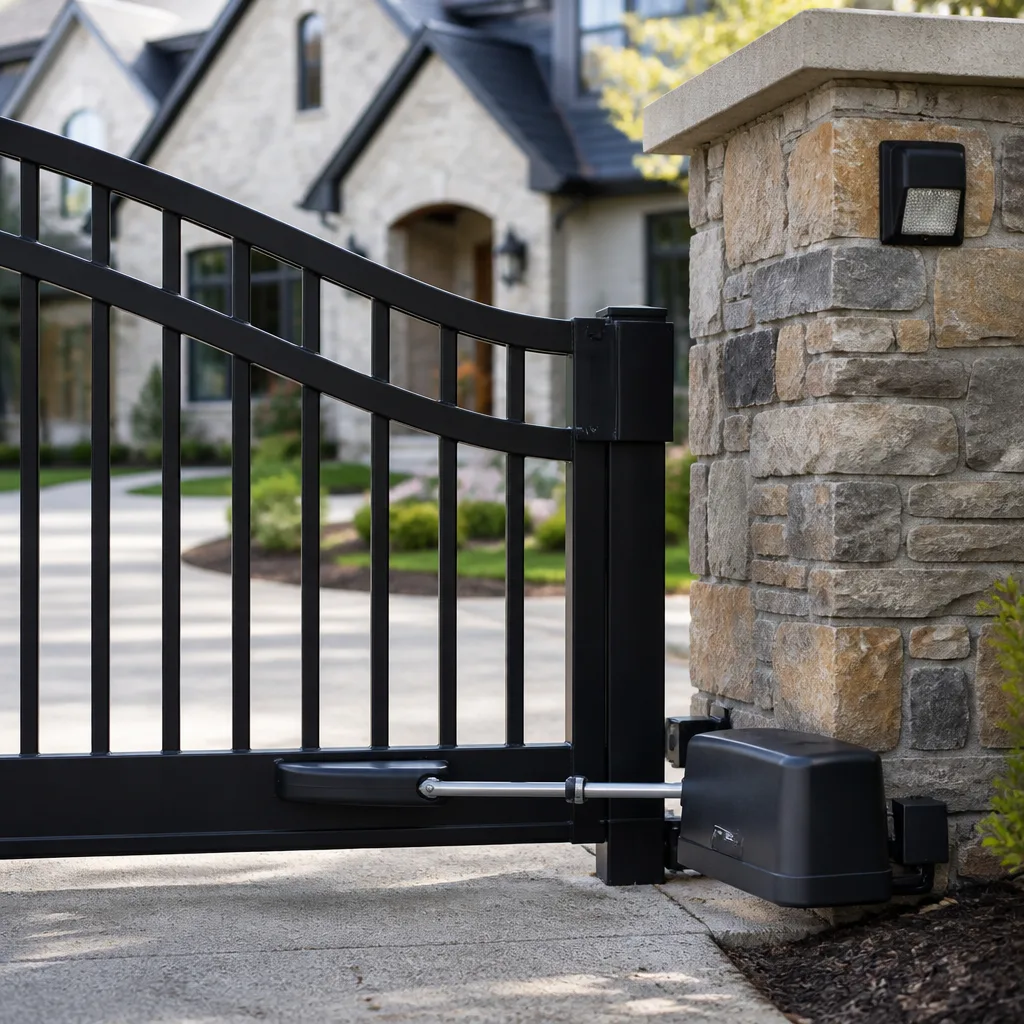
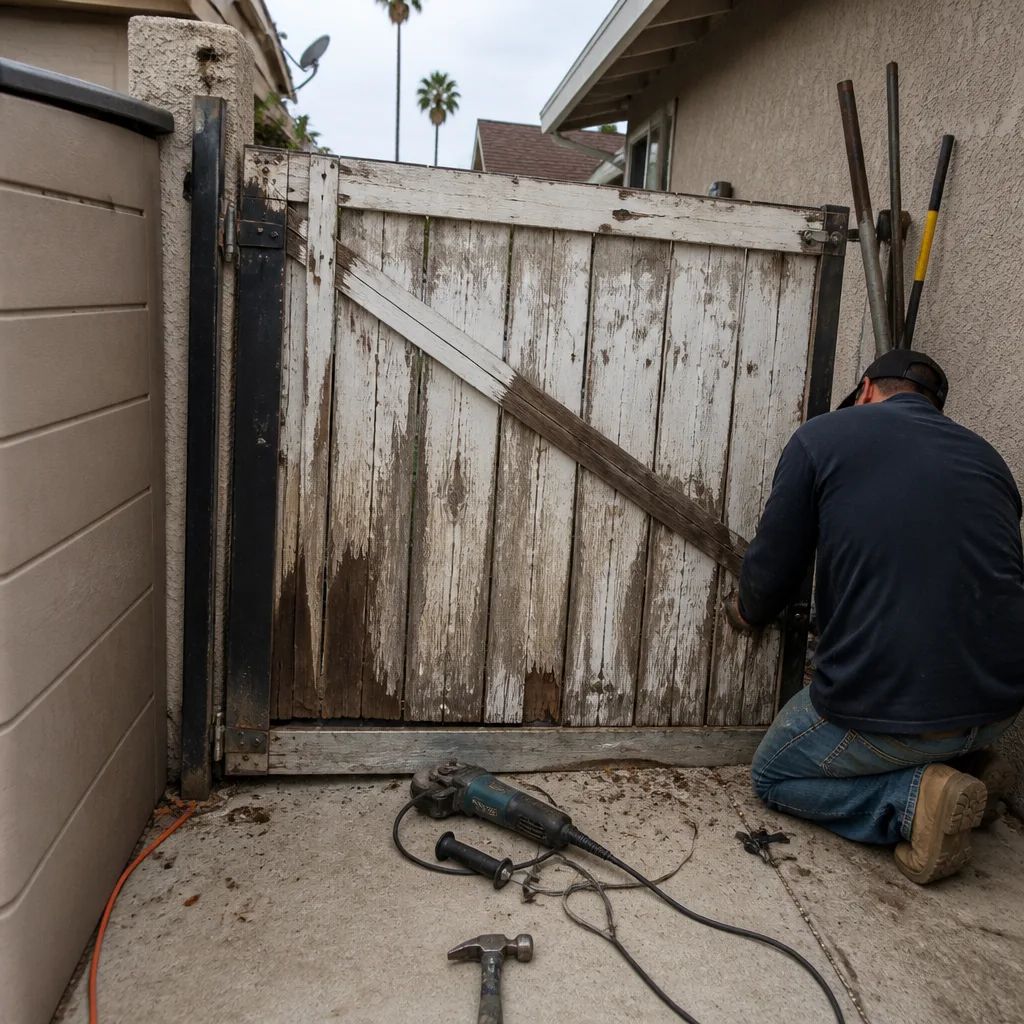 Before
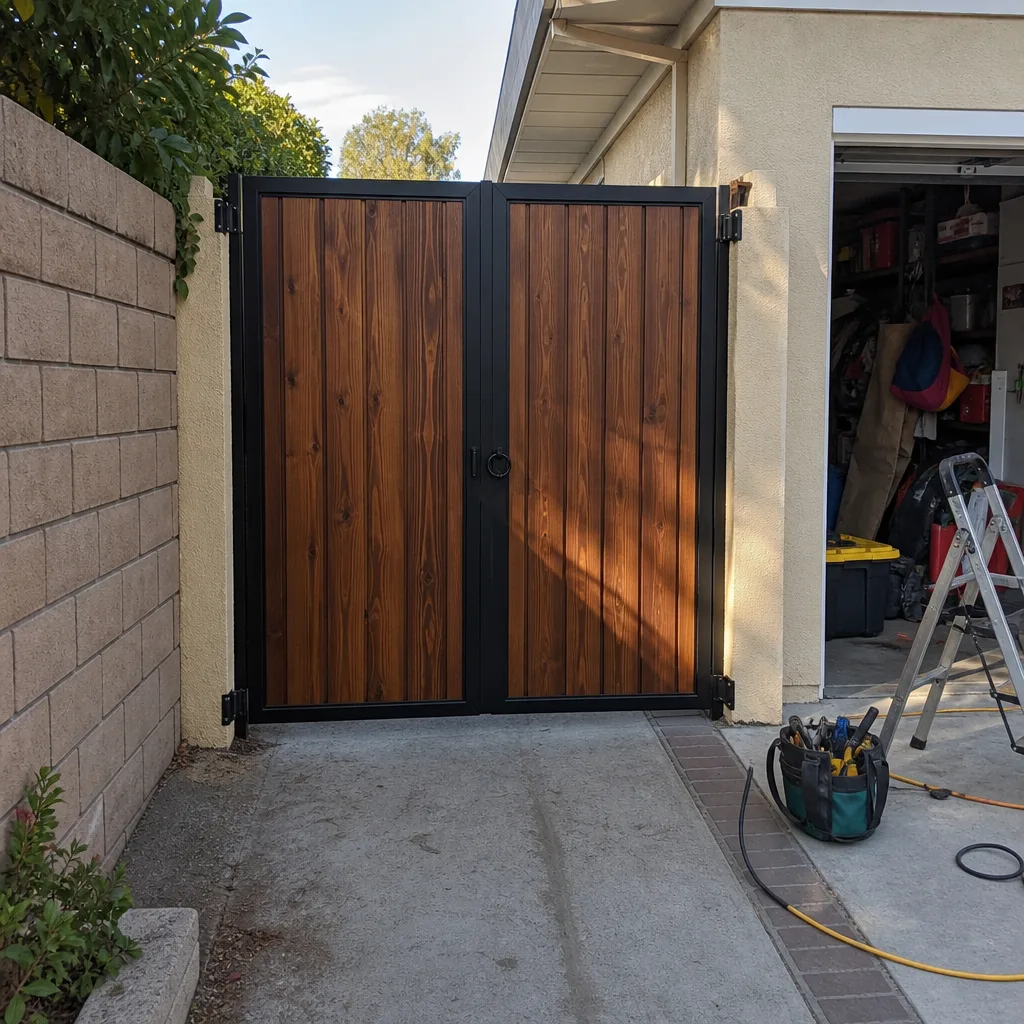 After
After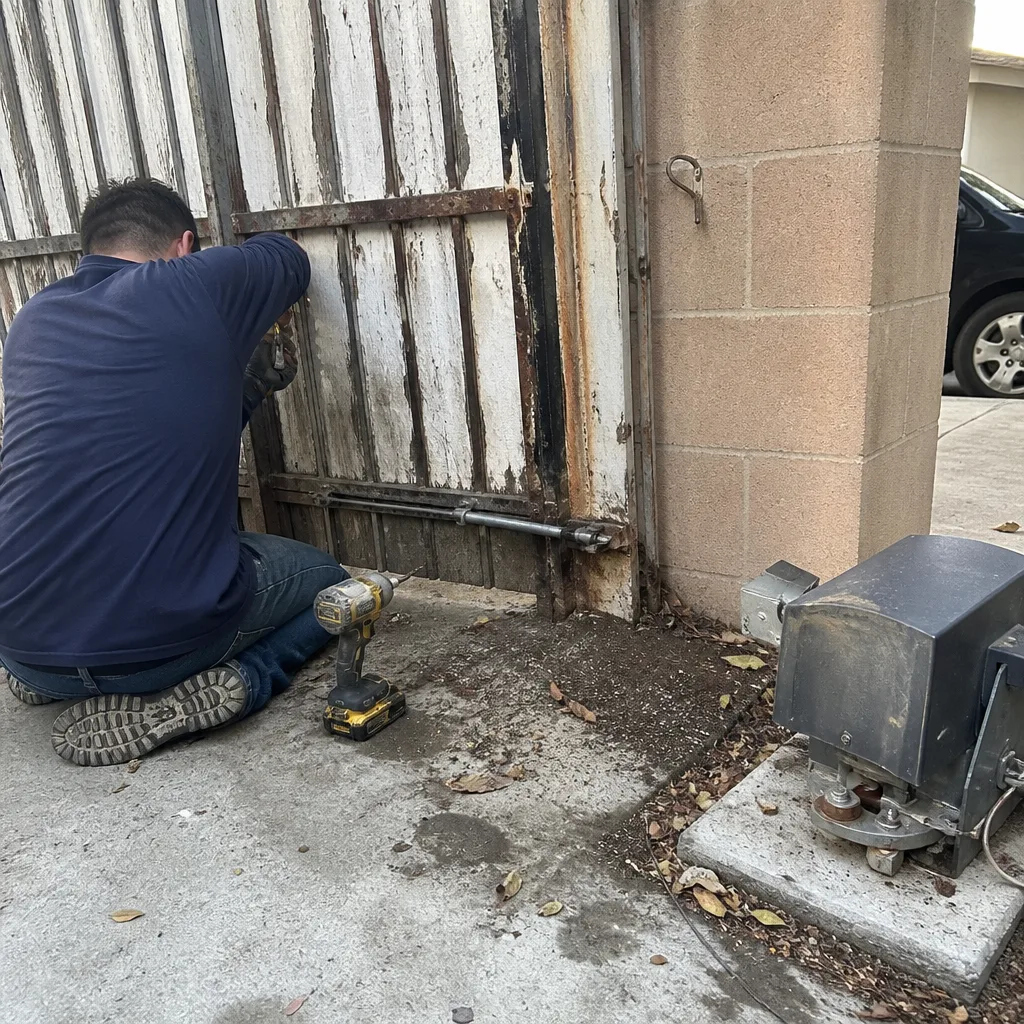 Before
 After
After Before
 After
AfterGate Repair Cost Breakdown: The Fullerton Homeowner’s Reference for 2026
Here is a number most Fullerton homeowners do not expect: roughly six out of ten gate repairs we perform are on gates less than fifteen years old. The ironwork is usually fine. The problem sits in the automation, the hinges that were never greased, or the control board that took a voltage spike during a Santa Ana wind event. The good news is that most of these failures are predictable, and predictable failures have predictable costs. This guide lays out exactly what Fullerton homeowners should expect to pay for gate repair in 2026, what drives the price up and down, and how to avoid paying twice. By the end, you will know what is normal, what is a red flag, and what should never appear on your invoice.
Quick Answer
Gate repair in Fullerton typically costs between $180 and $900 depending on whether the problem is mechanical or electronic. Simple fixes like hinge lubrication, limit switch adjustments, and sensor realignment run $180 to $350. Motor replacement, control board repair, and welded frame correction run $450 to $1,400. A full gate replacement in Fullerton starts around $2,800 and rises with length, material, and automation.
Table of Contents
- What Actually Drives Gate Repair Costs in Fullerton
- Typical Price Ranges by Repair Type
- Fullerton-Specific Factors That Change the Price
- Repair vs. Replace: The Fullerton Decision Framework
- What You Can Check Yourself (And What You Should Never Touch)
- How to Get a Fair Price in Fullerton
- Common Mistakes to Avoid
- When to Call a Professional
- Frequently Asked Questions
What Actually Drives Gate Repair Costs in Fullerton
Gate repair pricing is not a mystery. It comes down to three things: the part that failed, the time it takes to get to that part, and whether the gate is safe to work on while the technician does the job. Every quote you receive from a Fullerton gate company is built on those three variables, whether the company says so or not.
Parts are the most obvious cost. A limit switch that tells the gate where to stop costs $30 to $80. A control board for a LiftMaster or FAAC opener runs $300 to $600. A full motor assembly for a Viking or BFT unit can run $700 to $1,200. When you look at a repair invoice, the parts line is usually the easiest to understand. But the parts are rarely the largest line item, and that surprises people.
Labor is where Fullerton gate repair prices vary the most. Some failures take twenty minutes to diagnose and fix. Others require removing the gate from its hinges, cutting out a section of rusted post, welding in a new sleeve, and re-hanging the gate so it closes square. That is a half-day job, and it requires a service truck set up for welding, not a pickup with a toolbox. Companies that do not do their own welding subcontract that work, and the price reflects the markup.
Access and safety also shape the price. A gate that is stuck closed but not seized can be worked on in place. A gate that has come off its track and is leaning against a stucco column needs to be stabilized before anything else happens. If the technician has to work around gas lines near the driveway or the gate is on a slope, the job takes longer and the safety precautions add time. In Fullerton, where many homes in the Raymond Hills and Sunny Hills neighborhoods sit on graded lots, driveway slope is a real pricing factor.
Our company, Ironworks Gate Co., has been repairing gates in Fullerton for more than a decade under owner Victor Salinas. We quote jobs the same way every time: identify the failed part, figure out the labor required to access and replace it safely, and factor in any conditions on the property that change the scope. Then we write the number down and stand behind it.
Typical Price Ranges by Repair Type
The table below reflects what Fullerton homeowners are paying in 2026 for common gate repairs. These ranges assume a standard single-driveway residential gate, 12 to 16 feet wide, with a working electrical supply nearby. Sloped driveways, dual gates, and ornamental ironwork raise labor time.
- Hinge replacement (set of two): $220 to $480. Includes removal, new welded or bolted hinges, and re-hanging the gate level.
- Gate sag correction and frame realignment: $180 to $350. Fixes a gate that drags on the driveway or no longer latches.
- Limit switch adjustment or replacement: $160 to $280. Most common on LiftMaster and Mighty Mule residential openers.
- Control board replacement: $380 to $650. Covers board cost, removal of the old board, programming, and testing across all safety sensors.
- Full motor replacement: $550 to $1,200. Depends on brand. FAAC and BFT motors run higher than Ghost Controls or Mighty Mule.
- Safety sensor realignment or replacement: $150 to $300. Often needed after a vehicle bumps the gate or a post shifts.
- Welded crack repair (wrought iron or steel): $200 to $500 depending on the location of the crack and whether the gate must be removed for the weld.
- Full automation retrofit (new opener, wiring, sensors, remote programming): $1,800 to $3,200.
- Complete gate replacement (single standard driveway): $2,800 to $8,000. Steel runs lower, custom ornamental iron runs higher.
These numbers are averages for the Fullerton market. If a quote comes in far below these ranges, ask what is not included. If it comes in far above, ask for the line items. A legitimate gate company will explain the difference without hesitation. A company that gets defensive about a breakdown is telling you something you should hear.
Fullerton-Specific Factors That Change the Price
Fullerton is not Anaheim, and it is not Yorba Linda. The city has its own housing stock, its own weather patterns, and its own gate failure profile. Understanding the local factors that push a repair price up or down will help you evaluate any quote you receive.
First, the housing stock. Fullerton has a high concentration of homes built between the 1950s and the 1980s. Many of those driveways were designed for two cars and a boat, which means wide gates. A wider gate weighs more, and weight is the enemy of both hinges and motors. When we service a 16-foot steel gate in the Golden Hill neighborhood, the motor is working harder than a 12-foot aluminum gate in a newer development. Heavier gates wear out parts faster, and when they fail, the repair often involves more than just swapping a part.
Second, the climate. Fullerton gets hot, dry summers and occasional heavy rain in winter. The summer heat breaks down capacitor-based control boards faster than coastal cities see. The winter rains cause the clay-heavy soils in parts of Fullerton to swell and shift, which can move a gate post just enough to throw off the alignment. A gate that worked perfectly in October may fail in January, not because anything broke, but because the ground moved. This is a call we get every winter from homeowners near the Fullerton Creek corridor.
Third, the codes. Fullerton enforces Orange County building codes for gate installation, including safety requirements for automated gates. Any new gate or motor installation must include entrapment protection: photo eyes, reversing edges, or both. If your existing gate lacks proper safety sensors and you are installing a new motor, the sensors are not optional add-ons; they are required. That affects the quote. A company that does not mention safety sensors when quoting a motor replacement is either not planning to install them, which is a code violation, or is going to add them as a change order later.
Fourth, the neighborhoods. Fullerton’s older neighborhoods like Jacaranda and Troop present different challenges than the recent builds near Amerige Heights. Older gates are often heavier iron, built well but now showing fatigue at the welds and wear at the hinges. Newer gates are typically lighter aluminum but depend heavily on electronics that can fail without warning. We see older mechanical systems in need of welding and newer electronic systems in need of board work. The price patterns follow the failure patterns.
Repair vs. Replace: The Fullerton Decision Framework
The decision to repair or replace a gate comes down to a simple calculation: add up the cost of the repair, add the realistic remaining life of the gate, and compare it to the cost of replacement amortized over the next twenty years. Most Fullerton homeowners can work through this in ten minutes.
- Calculate repair cost. Get a written estimate for the specific repair needed. Do not accept a verbal ballpark for this exercise. A written number forces clarity.
- Estimate remaining gate life. A well-built steel gate that is ten years old and has been maintained will often last another fifteen or twenty years. A gate that is rusting through at the bottom rail, has been welded twice already, and shows fatigue at every hinge point has less than five years left.
- Add the cost of likely future repairs. If the gate is at the stage where hinges fail one year, the motor the next, and welding the year after, those are separate invoices. Stack them up over the next five years.
- Compare to replacement cost. A new steel gate installed in Fullerton runs $2,800 to $8,000. If your projected repair costs over five years exceed 60% of a new gate, replacement starts making financial sense.
- Consider the non-financial factors. A failed gate means an open driveway, and in Fullerton that often means a backyard open to the street. For many homeowners, the security value of a guaranteed-functioning gate closes the case faster than the spreadsheet does.
Our rule of thumb when we advise Fullerton customers: if the existing gate is structurally sound, repair it. Even a $1,200 motor replacement is less than half the cost of a new gate. But if the iron itself is failing, no amount of motor work will save it. We have seen gates in the neighborhood around Downtown Fullerton that are forty years old and still serviceable, and gates that are eight years old and not worth a $400 weld. The iron tells you the truth if you look closely.
What You Can Check Yourself (And What You Should Never Touch)
There are a handful of gate issues a Fullerton homeowner can safely diagnose without any tools. Knowing what to look for saves you a service call when the problem is minor, and it gives you a better conversation with the technician when the problem is not.
You can safely check these items yourself:
- Hinge movement. Look at the top and bottom hinges. If one shows a visible gap when the gate is closed, or if you can see daylight through a hinge that should sit tight, you have a wear issue. Write that down.
- Ground clearance. A gate that scrapes the driveway is either sagging or the post has shifted. Mark where the gate touches the ground.
- Remote range. If the remote only opens the gate from ten feet away, note it. That tells the technician something about the receiver or the antenna.
- Safety sensor alignment. If the gate starts to close and then reverses for no reason, the photo eyes may be misaligned. You can look at them and see if they are pointed at each other or knocked askew.
You should never attempt to work on the following:
- Gate spring tension. Torsion springs on heavy gates store enormous energy. A spring that releases under load can cause serious injury. This is not a DIY job, ever.
- Control board wiring. Gate openers run on line voltage. Touching the wrong terminal on a control board can shock you and destroy the board. The board costs several hundred dollars to replace.
- Gate removal. A 16-foot steel gate weighs several hundred pounds. Removing it from its hinges without proper support equipment is how people get hurt. Technicians use gate jacks and spotters for a reason.
- Welding repairs. Structural welds on a moving gate need to be done correctly or the repair fails, often catastrophically. This is a trade, not a weekend project. Victor Salinas has spent decades on this work, and the difference between a proper weld and a failed one is invisible to the untrained eye.
How to Get a Fair Price in Fullerton
A fair price is a specific number, agreed in writing, for a specific scope of work. Anything less than that is a guess, and guesses turn into invoices. Here is how to get a fair price for gate repair in Fullerton.
- Get the diagnosis in writing first. A technician who says “your board is fried” has told you nothing. A technician who says “the control board is not sending voltage to the motor, and here is the model number and the replacement cost” has told you everything. Ask for the diagnosis before you approve the repair.
- Ask for the line-item breakdown. Parts, labor, any trip charge, any disposal fee. The invoice should itemize each. If a company will not break it down, find another company.
- Confirm the total before work starts. You should know the final number before the technician touches a tool. At our company, the price is quoted and agreed before any work starts. No exceptions, no surprises. If a company says “we will see how it goes,” they are telling you the price may change. You have the right to say no to that.
- Ask whether the repair is warrantied. Most reputable Fullerton gate companies offer some warranty on parts and labor. Ours is the 90-Day Done Right Promise: a written guarantee on every job, no paperwork, no arguments. If it is not right, we come back and make it right. Every time, on every job.
- Get a second opinion if the first quote seems high. We offer a free second opinion on any written estimate in Fullerton. If another company quoted you a price that feels inflated, bring us the estimate and we will give you our honest read on it.
One more thing worth saying: the lowest price is rarely the fairest. A repair done with the wrong part, or done without addressing the underlying cause, costs more in the long run. We have seen Fullerton homeowners pay $200 for a cheap hinge replacement, then pay another $800 six months later to fix the gate that fell off those hinges. A fair price is not the cheapest price. A fair price is the one that fixes the problem for good.
Common Mistakes to Avoid
- Ignoring a gate that is getting slower. A gate that takes longer to open than it did last year is telling you the motor or the power supply is struggling. Waiting until it stops completely usually means a more expensive repair. In Fullerton’s summer heat, a struggling motor fails faster.
- Lubricating hinges with the wrong product. Spray lubricants like WD-40 displace water but do not provide lasting protection for gate hinges. They wear off quickly, and the hinge grinds metal-on-metal again. Use a heavy lithium grease designed for high-load pivots.
- Adding a faster motor to an old, heavy gate. Speeding up a heavy gate is not a fix; it is a way to break the gate faster. The problem is not always the motor. Sometimes the gate is too heavy for the hinges, and the hinges need work, not the motor.
- Accepting a quote over the phone without seeing the gate. A company that quotes a specific price before seeing the gate is guessing. The gate’s condition, the driveway slope, and the existing opener all change the price. A phone quote is a marketing tool, not a contract.
- Letting a non-specialist work on an automated gate. A general handyman who fixes fences will likely make an automated gate’s problem worse. Gate automation is a specialized trade involving line voltage, control electronics, and safety sensors. Hire someone who does this work every day.
- Skipping the safety sensor check after any repair. If your gate was repaired recently and the safety sensors were disconnected or bypassed, the gate can close on a person or vehicle. After any repair, confirm the auto-reverse function works. A gate that does not reverse when it meets resistance is a hazard, not a convenience.
When to Call a Professional
Call a gate professional when the problem involves any component that moves the gate, powers the gate, or controls the gate’s movement. That includes motors, control boards, hinges, springs, sensors, keypads, and any wiring. A gate is a heavy object under mechanical or electrical control, and failures in these components are not cosmetic. They get worse, often quickly.
Call a professional when your gate is stuck open and you cannot secure your property. Call when the gate reverses unexpectedly or makes a grinding sound. Call when your remote works inconsistently, because that is a sign of a failing receiver or power supply. Call when you see rust at the weld joints or the gate is visibly sagging. And call before you try to fix any of these things yourself. A trained technician sees the failure behind the symptom, and the repair costs less when it is corrected early. Ironworks Gate Co. offers free estimates in Fullerton. Call (279) 201-0835 and a live person answers, any time of day or night.
Frequently Asked Questions
Gate repair in Fullerton typically costs between $180 and $900. Minor mechanical repairs like hinge lubrication and limit switch adjustments run $180 to $350. Motor replacements and control board repairs run $450 to $1,400. A complete gate replacement starts around $2,800. Call (279) 201-0835 for an exact quote on your gate - estimates are free.
In most cases, yes. Most gate repairs are completed in a single visit, and we keep the parts for the most common Fullerton gate failures on our trucks. If the problem requires a part we do not have in stock, we order it and schedule the repair as soon as it arrives. Call (279) 201-0835 and a live person answers 24 hours a day.
We service nine major gate automation brands: LiftMaster, FAAC, BFT, Linear, Viking, Ghost Controls, DoorKing, Elite, and Mighty Mule. That covers most residential and light-commercial openers installed in Fullerton over the past thirty years. If your opener is not on that list, call us anyway; we will tell you honestly whether we can help.
Fullerton’s clay-heavy soil expands when it gets wet, which can shift the gate post slightly and throw off the alignment between the gate and the sensors or the latch. The gate may scrape, fail to close, or trigger the auto-reverse. This is a regular winter call for us in neighborhoods near the Fullerton Creek. The fix usually involves post shimming or sensor realignment, and it is less expensive than it sounds.
Repair the gate if the structure is still sound. A new motor or control board is far cheaper than a full replacement. Replace the gate if the iron itself is failing: rust through the bottom rail, repeated weld breaks, or hinges pulling out of the post. When the structure is done, new automation will not save it. We will give you an honest assessment either way, in writing, before you spend a dollar.
The 90-Day Done Right Promise covers the work we performed. If it is not right, we come back and make it right. No paperwork, no arguing, no exceptions. Every gate repair and installation we complete in Fullerton carries this written guarantee. That is the standard Victor Salinas has held the company to since he began serving Fullerton, and it is the same standard on the 400th job as the first.
The Bottom Line
Gate repair in Fullerton costs between $180 and $900 for most failures, with full automation retrofits and replacements running higher. The price is driven by the failed part, the labor to access it, and the conditions on your property: gate weight, driveway slope, and soil movement all matter here. Get the diagnosis in writing, get the total before work starts, and get a warranty on the work. The cheapest quote rarely fixes the problem for good, and the most expensive quote rarely guarantees quality either. What matters is a specific number, a specific scope, and a company that stands behind the work. We are that company. Call (279) 201-0835 for a free estimate, and we will tell you exactly what your gate needs and what it will cost before you decide anything.
Written by Victor Salinas, Owner at Ironworks Gate Co., serving Fullerton since 2013.